Common Metal Stamping Defects & Solutions
March 10, 2026
How to Import Custom Parts from China
March 11, 2026Plastic Materials Guide: ABS, PC, PP, PA
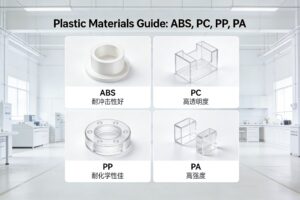
Choosing the right plastic material is critical for successful injection molding projects. The material you select directly impacts part durability, cost, appearance, and performance in its intended application. Four plastics dominate the injection molding industry due to their versatility, affordability, and performance: ABS, PC, PP, and PA (Nylon). This guide breaks down each material’s properties, ideal uses, advantages, and limitations to help you make the best choice for your custom plastic parts.
ABS (Acrylonitrile Butadiene Styrene)
ABS is the most widely used general-purpose injection molding plastic, favored for its balanced performance and low cost. It offers excellent impact resistance, rigidity, and ease of processing, with a low melting point that speeds up production. ABS is easy to color, texture, and plate, making it perfect for consumer electronics housings, toys, automotive interior parts, kitchen appliances, and hardware components. Key Benefits: Affordable, easy to mold, good impact resistance, customizable finishes. Limitations: Low heat resistance (not suitable for high-temperature applications), less durable than engineering-grade plastics. Best For: Low to high-volume general-use parts with moderate durability needs.
PC (Polycarbonate)
PC is a high-performance engineering plastic known as “unbreakable plastic” due to its exceptional impact resistance and transparency. It withstands high temperatures and heavy impact, making it ideal for safety-critical parts. PC is fully transparent and can be tinted or colored, making it popular for protective covers, optical lenses, automotive light housings, safety equipment, and electrical components. Key Benefits: Ultra-strong, heat-resistant, transparent, long-lasting. Limitations: Higher cost than ABS, prone to scratching, more difficult to mold. Best For: High-durability parts requiring strength, clarity, or heat resistance.
PP (Polypropylene)
PP is a lightweight, flexible, and chemical-resistant plastic with exceptional fatigue resistance, meaning it withstands repeated bending without breaking. It is one of the most affordable injection molding materials and is food-safe, making it ideal for packaging, containers, living hinges, medical devices, and food-contact components. PP resists moisture, chemicals, and corrosion, with a low density that keeps parts lightweight. Key Benefits: Low cost, flexible, chemical-resistant, recyclable. Limitations: Low rigidity, not ideal for load-bearing parts. Best For: Flexible parts, living hinges, food-safe components, and cost-effective lightweight parts.
PA (Polyamide/Nylon)
PA, commonly known as Nylon, is a heavy-duty engineering plastic with exceptional strength, wear resistance, and thermal stability. It has low friction properties, making it perfect for moving parts like gears, bearings, and pulleys. PA withstands harsh industrial environments, oil, and chemicals, making it a top choice for automotive under-hood parts, industrial components, and mechanical parts. Key Benefits: High strength, wear-resistant, low friction, heat-resistant. Limitations: Absorbs moisture over time, higher cost than general-purpose plastics. Best For: Industrial parts, gears, bearings, and high-wear mechanical components.
How to Choose the Right Plastic Material
Consider three key factors when selecting a plastic: your part’s end use, operating environment, and budget. For general, low-cost parts, choose ABS or PP. For high-strength, durable parts, opt for PC or PA. Consult with your injection molding manufacturer to test material samples and confirm compatibility with your application. Most manufacturers offer free material consultation to ensure you select the optimal plastic for your project.
CTA: Contact our injection molding team for personalized material recommendations and a free project quote.