
Sheet Metal Development
November 9, 2025
Key Factors Affecting Blank Cutting of Sheet Metal Parts
March 9, 2026Table of Contents
ToggleSheet Metal Layout and Cutting: A Comprehensive Guide
Introduction to Sheet Metal Layout and Cutting
 Layout and cutting are the foundational processes in sheet metal fabrication, serving as the critical first steps in transforming raw materials into precise components. In the intricate world of metal fabrication, the ability to accurately translate design specifications into physical templates—a process known as “lofting” or “layout”—directly impacts the quality, efficiency, and cost-effectiveness of the final product. This is especially true for complex, large-scale, or single-piece items where traditional dimensioning alone falls short. This guide delves deep into the symbols, techniques, and best practices essential for mastering sheet metal layout and cutting.
For projects demanding precision and reliability, partnering with an experienced manufacturer is key. MetalFabricationChina is a professional metal fabrication and plastic molding manufacturer in China, offering expertise that bridges the gap between design and flawless production.
Part 1: The Art and Science of Layout (Lofting)
1.1 The Fundamental Role of Layout
Layout is far more than simple marking. It is a comprehensive preparatory stage where a full-scale template or “pattern” is developed directly from engineering drawings. This process involves not only defining the geometric shape and size of each part but also pre-emptively accounting for all downstream manufacturing factors. These include material grain direction, bend allowances (for k-factor and bend deduction), weld shrinkage, joint configurations, and assembly clearances. This proactive problem-solving distinguishes professional layout from mere shape unfolding.
1.2 Advantages of Direct Layout Methods
For many components, especially non-standard or connection pieces like gusset plates, nodal joints, and complex bracketry, direct layout on the shop floor is often faster and more reliable than pure mathematical calculation. The size and geometry of such parts are influenced by multiple variables: member dimensions, angles of inclination, required weld lengths, and fit-up tolerances. A physical layout allows fabricators to:
-
Visualize and Verify: Catch interferences and design issues before cutting expensive material.
-
Optimize Material Use: Manually arrange (“nest”) patterns to minimize scrap.
-
Determine True Shapes: Accurately develop the flat pattern for complex transitions (e.g., round-to-rectangular “round pipes” or cones).
The resulting full-scale template becomes the indispensable master reference for all subsequent assembly work.
Part 2: Essential Symbols in Layout and Cutting
While not universally standardized, a set of conventional symbols has evolved within the sheet metal and structural steel industry for clear workshop communication. Understanding these symbols is crucial for accurate fabrication.
Table 1: Common Marking-Out Symbols and Their Meanings
| Symbol (Sketch) | Name & Description |
|---|---|
| ━━ ━━ ━━ | Center Line: Represents the axis of symmetry or a critical reference line. It is marked by three punch marks (made with a center punch) at each end, spaced 20-30mm apart, placed 10-20mm from the line’s terminus. This ensures the line can be re-established if the surface mark fades. |
| ╳══════╳ | Cut Line / Break Line: Indicates the path for cutting. It is often marked with freehand chalk or paint marker dashes across the line. To preserve its location, small punch marks are made along the line [as shown in variant (b)]. |
| ▷────── | Single Bevel Edge Preparation: Denotes a beveled edge for welding. The symbol indicates the presence of a bevel; the exact angle (e.g., 30°, 45°), direction, and depth are specified separately in callouts. |
| ◁━━━▷ | Double Bevel Edge Preparation: Indicates a double-V groove weld preparation. Angle and dimensions are specified elsewhere. |
| ✓ | Machining Surface: Marks an area that will undergo subsequent machining (e.g., milling, turning) to achieve final dimensions or surface finish. |
| ▷──────✕ Local Bevel |
Localized Bevel/Weld Prep: Used when the edge preparation does not run the full length of the piece. The symbol includes the length and location of the beveled section. |
| ● ⊕ △ □ | Hole Markings: The center of a hole is precisely located and marked with a center punch. A two-step punching process is common: first with a 60°-90° punch for initial location, then with a 90°-120° punch to enlarge and clarify the mark for drilling. Different shapes (circle, triangle, square) drawn around the mark can distinguish between hole diameters. |
| ┌─┐ (Bend Area) |
Bend/Bending Area: Highlights the section of the material to be bent. The lines often indicate the bend line and the non-bending sections. |
| ┤ └─┘ |
Hem/Fold Line for 90° Bends (t < 5mm): A specific symbol for 90-degree bending on relatively thin sheet metal (typically thickness < 5mm). |
| ◠ ─── | Rolling/Curving Area: Denotes sections requiring rolling to form an arc or cylinder. Common in parts like simple curved brackets or the transition zones of “round pipe” fittings where flat plates meet curved surfaces. |
Table 2: Advanced Marking Symbols
| Symbol | Name & Description |
|---|---|
| ┏━ ┃ S ┗━ |
Inspection/Check Line: Used for quality control, especially on rectangular or trapezoidal blanks. A short line (e.g., 100mm long) is marked at a fixed, standard distance (e.g., 50mm) from the blank’s edge at each corner. Precise punch marks on these lines allow for easy re-verification of blank dimensions after handling or before further processing. |
| ⟋ ⟍ *α/α* |
Weld Bevel/Groove Symbol (General): Generic symbols indicating beveling for welding. They require accompanying text or a detail callout specifying: 1. Single-side or double-side. 2. Bevel angle (α). 3. Length of the beveled section. 4. Orientation (e.g., “bevel on top surface”). |
| I – A II – B (with connecting lines) |
Nesting/Assembly Identification: Used in layout nesting diagrams. Roman numerals (I, II, III) may identify different parts or plates. Letters (A, B) and connecting lines indicate how parts interface, join, or their relative position in the assembly sequence. This is critical for complex fabrications with multiple similar parts. |
Part 3: Standard Symbols for Structural Shapes
When creating or interpreting cutting lists and material schedules, abbreviated symbols for standard structural shapes ensure clarity and conciseness.
Table 3: Standard Shape Designation Symbols
| Shape Name | Symbol | Example & Format | Key Parameters |
|---|---|---|---|
| Steel Plate | — |
— t x L x W |
Thickness (t), Length (L), Width (W) |
| Angle Steel | L |
L a x b x t x L |
Leg Dimensions (a, b), Thickness (t), Length (L) |
| Steel Pipe/Tube | ○ or ⌀ |
○ OD x t x L or ⌀ OD x t x L |
Outer Diameter (OD), Wall Thickness (t), Length (L) |
| Channel Steel | [ or C |
[ Spec x L (e.g., [200x75x9) |
Channel Specification/Size, Length (L) |
| I-Beam | I |
I Spec x L (e.g., I 250×125) |
I-Beam Specification/Size, Length (L) |
| Checkered Plate | ※ or # |
※ t x L x W - Pattern |
Thickness (t), Length (L), Width (W), Pattern Type |
| H-Beam (Wide Flange) | H |
H h x b x L |
Height (h), Flange Width (b), Length (L) |
Part 4: The Cutting Process: From Layout to Blank
4.1 Transferring the Layout
Once the layout is confirmed, the information is transferred to the raw material. Methods include:
-
Scribing: Using sharp tools for fine, permanent lines on metal.
-
Punching: As described, for critical points and hole centers.
-
Painting/Marking: Using specialized metalscribe paints or pens for high visibility.
4.2 Cutting Techniques
The chosen cutting method depends on material type, thickness, required precision, and volume.
-
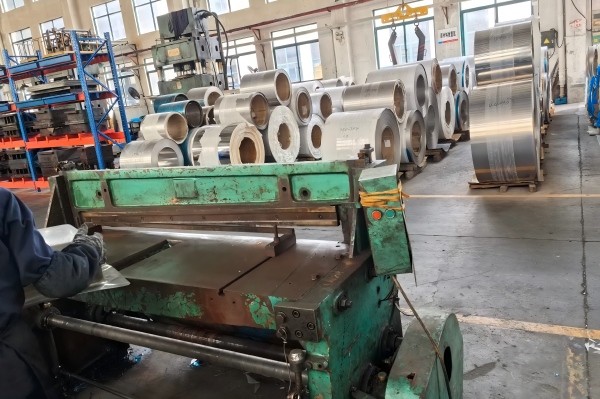
Mechanical Shearing: Ideal for straight-line cuts on sheets and plates. Fast and efficient but limited to linear paths.
-
Thermal Cutting: Includes Oxy-Fuel Cutting (for thick carbon steel), Plasma Cutting (versatile for most conductive metals), and Laser Cutting (for high precision and complex contours with excellent edge quality). MetalFabricationChina utilizes advanced CNC laser and plasma systems to ensure precision and repeatability.
-
Waterjet Cutting: A cold-cutting process using high-pressure water and abrasive, perfect for materials sensitive to heat affectation (e.g., some tool steels, aluminum, composites).
4.3 Tolerances and Quality Control
The initial layout and cutting stages set the foundation for all tolerances. Key considerations include:
-
Kerf Allowance: Accounting for the material removed by the cutting tool (laser beam, plasma arc, saw blade).
-
Part Variation: Anticipating distortion from heat input during thermal cutting.
-
First-Article Inspection: The first part cut from a new layout must be rigorously checked against the master template or CAD model before proceeding with full production.
Part 5: Best Practices and Modern Integration
5.1 The Digital Transformation: From Manual Lofting to CNC
While manual layout skills remain vital for prototyping and troubleshooting, modern fabrication is dominated by digital workflow:
-
3D CAD Model: The single source of truth.
-
CAM Software: Automatically generates flat patterns (developments), applies bend allowances, and creates optimal nesting layouts to maximize material utilization.
-
CNC Instructions: The CAM output drives CNC cutting machines (laser, plasma, waterjet) and even CNC punching presses with extreme accuracy.
This digital chain minimizes human error and dramatically speeds up the process from design to finished blank. A manufacturer like MetalFabricationChina leverages this integrated CAD/CAM/CNC pipeline to deliver consistent, high-quality parts at scale.
5.2 The Enduring Value of Core Skills
Despite advanced software, understanding the principles behind the symbols and processes is irreplaceable. Skilled fabricators can:
-
Troubleshoot software-generated nests or developments.
-
Create one-off templates quickly without programming.
-
Visually inspect and validate parts against intended function.
-
Effectively communicate with designers and engineers using standard shop symbols.
Conclusion
Mastering the symbols and techniques of sheet metal layout and cutting is fundamental to successful metal fabrication. It bridges the gap between abstract design and tangible product. From the traditional punch mark on a centerline to the digital code driving a 10kW laser cutter, the goal remains the same: to accurately and efficiently transform raw metal into precisely shaped components ready for forming, welding, and assembly.
For businesses seeking to turn designs into reality, mastering these fundamentals is essential, but so is choosing the right partner. Combining in-house knowledge with the capabilities of a seasoned producer ensures success. MetalFabricationChina is a professional metal fabrication and plastic molding manufacturer in China with the expertise, technology, and quality systems to handle complex layouts and precision cutting, ensuring your project is built on a solid foundation from the very first step.